
Waukegan Epoxy Flooring installs epoxy garage floors in Waukegan, IL, serving surrounding cities including Park City, Gurnee, North Chicago, Beach Park and Green Oaks. In more than 20 years of coating concrete, we have learned that a garage floor lives or dies on what happens before the first coat: how the slab is opened up, whether it is passing moisture, and whether its cracks are still moving. Our garage floor work starts there, and the color comes later.
Every garage we coat is ground with diamond tooling, never acid etched, and every quote carries moisture testing as a visible line rather than an upsell after a blister shows up. The proposal names the base coat, the broadcast, the topcoat and the finished thickness, so you can hold the finished floor up against the paperwork.
A garage in Lake County takes brine off tires for months a year, hot tires in summer and dropped tools all year. We build garage systems around those loads, and we say plainly when a slab needs repair, replacement or simply a warmer month before it is ready.
What Goes Into a Garage Floor System
A 100% Solids Epoxy Base Coat
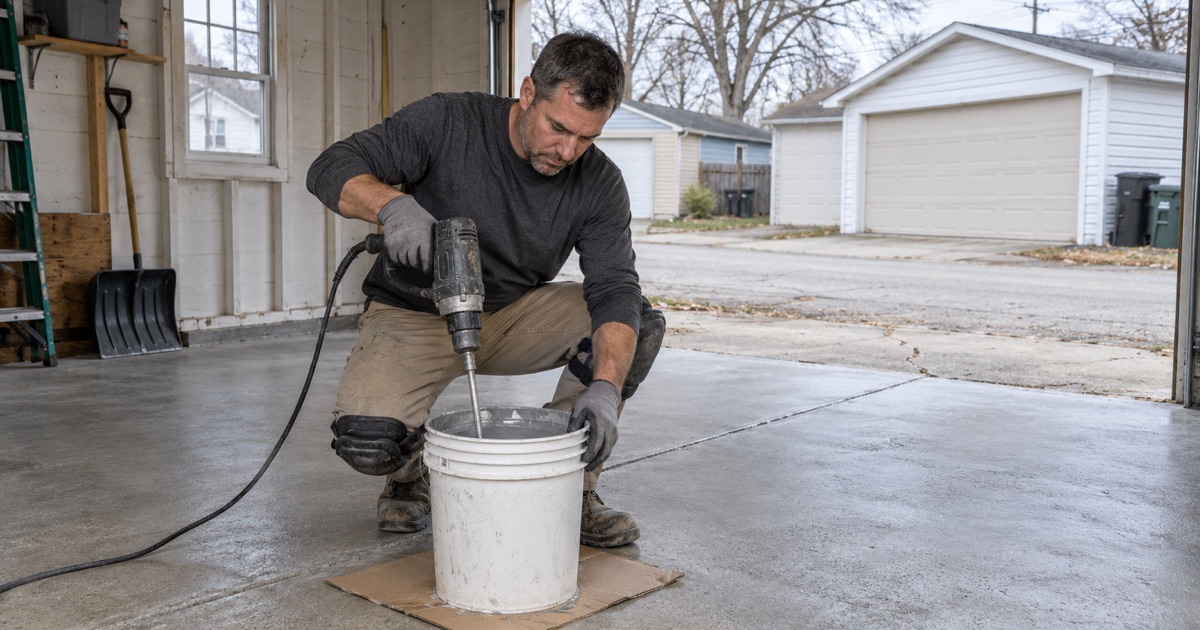
The base coat does the bonding and builds most of the thickness. We use 100% solids epoxy, which cures without a carrier evaporating out of it, so what is rolled on is what stays on the floor. It soaks into the ground profile and locks the system to the concrete.
Water-based kit epoxies are mostly carrier by volume, which is why they dry thin and why a kit floor can look fine for a season and then begin lifting in the tire paths.
Vinyl Flake or Quartz Broadcast Layer
While the base is still wet, we broadcast vinyl flake or quartz aggregate into it. Flake gives color, pattern and a forgiving look that hides dust and small slab flaws. Quartz builds texture and hardness for a working garage or a shop bay.
We broadcast to refusal on most garages, meaning chips go down until the wet resin will take no more. The excess is scraped and vacuumed off once the base cures, which leaves a dense, even layer for the topcoat to seal.
A Polyaspartic or Polyurea Topcoat
The topcoat is the wear layer and the part you see. Polyaspartic and polyurea topcoats are aliphatic, so they hold color under the sunlight that comes through an open garage door rather than ambering like a plain epoxy. They also stand up well to road salt, gasoline drips and abrasion from grit.
Lake County Conditions a Garage Floor Has to Survive
Brine From Calcium Chloride and Rock Salt
Waukegan spreads thousands of tons of road salt a year, and the slush rides into garages on wheel wells and tires. Calcium chloride brine soaks into bare concrete, freezes and thaws inside it, and scales the surface off over a few winters. A sealed, continuous garage coating keeps that brine on top where it can be squeegeed out.
We pay particular attention to the apron and the first few feet inside the door, where brine pools and where a thin coating wears first. That strip often gets extra build or extra texture.
Slabs Poured Without a Vapor Retarder
The 2021 International Residential Code exempts garage slabs from the under-slab vapor retarder rule through IRC R506.2.3, and many older garages were poured long before anyone asked. A slab with nothing under it can pass vapor up into a coating, and the pressure shows up as blisters or bubbles.
That is why moisture testing is in every scope. We start with an ASTM D4263 plastic sheet test and move to ASTM F1869 calcium chloride or ASTM F2170 relative humidity testing when the first read suggests a problem.
Hot Tire Pickup in Summer
A tire fresh off the highway is hot and soft, and on a thin or poorly cured coating it grabs the film and peels it up when the car pulls out. A full-build system on ground concrete, finished with a polyaspartic topcoat, resists that pickup because the bond to the slab is stronger than the grip of the tire.
Our Step-by-Step Epoxy Garage Floor Process
Step 1: Slab Assessment and Moisture Test
We look at the cracks, the old coatings, the drain and the slope, and we run the moisture test before we price the job. If a section of slab is heaved or broken, you hear it at this visit, not on install day.
Step 2: Diamond Grinding and Dust Control
We grind the whole floor to the ICRI surface profile the system calls for, cutting through sealers, paint and laitance down to clean, sound concrete. Grinders run on vacuums, and dust and slurry are collected on site rather than rinsed down the driveway toward a street drain.
Step 3: Crack, Spall and Joint Repair
Cracks are chased and filled, spalls are rebuilt with a repair mortar or epoxy paste, and control joints are dealt with according to the plan for the finished floor. Repairs are ground flush so they disappear under the coating.
Step 4: Base Coat and Broadcast
The base coat goes down at a measured spread rate, followed by the flake or quartz broadcast while it is still wet. We watch the slab temperature and the dew point spread while it cures to avoid amine blush on the surface.
Step 5: Topcoat and Cure
After the excess broadcast is removed, the topcoat goes on. We then give you the foot traffic and vehicle dates for your floor and leave written care instructions.
Choosing a Finish for Your Garage
Full Flake Broadcast Floors
Full flake is the most popular garage finish because it hides dust, tire marks and minor slab blemishes. Chip size and color blend change the effect from a fine granite look to a bold, high-contrast floor. We bring samples so you can see them in your own garage light.
Solid Color and Metallic Garage Finishes
A solid gray or tan coating is clean and easy to keep spotless, and it suits a workshop garage. Metallic epoxy turns a garage into a showpiece with swirling, marbled color, but it shows every grain of grit and needs more care at the door.
Texture and Sheen
A satin topcoat hides scuffs better than a high gloss, and a fine anti-slip grit can be added to the topcoat for walk paths. We help you balance easy cleaning against traction where you step out of the car with wet boots.
Garage Floors on Older Waukegan Slabs
Detached Garages and Decades-Old Concrete
Much of the city’s housing went up before 1980, and plenty of detached garages are older than the houses around them. Those slabs often carry oil soaked deep into the paste, old paint, and patches poured at different times with different mixes. We grind through the contamination we can reach and degrease what remains, and if a stain keeps wicking back up, we tell you before it shows under a fresh coating.
An old slab can also be thinner or weaker than a modern one. A section that sounds hollow when tapped, or crumbles under the grinder, is a repair or replacement conversation rather than a coating one.
Rental Garages and Two-Flat Owners
About half of Waukegan’s homes are rented, and many garages serve two units or a small building. We plan the floor with the owner, give tenants a clear schedule for when cars have to be out and when they can come back, and can often coat a shared garage in halves so someone always has a place to park.
Door Thresholds, Drains and the Apron Edge
The line where the garage floor meets the driveway apron takes brine, plow grit and the heaviest tire wear. We cut a clean termination edge there so the coating does not feather out and start peeling at the door. Floor drains are detailed so the coating turns down into them rather than sealing them over.
If the apron itself has settled and tips water back toward the garage, that is worth fixing first. A coating will not change which way the slab drains.
- 20+ Years Coating Floors
- Moisture Testing in Every Scope
- Free Written Estimates