
Waukegan Epoxy Flooring installs ESD flooring in Waukegan, IL, serving surrounding cities including Park City, Gurnee, North Chicago, Beach Park and Green Oaks. Static-control floors protect sensitive electronics, data equipment and some laboratory work from discharges too small for a person to feel but large enough to damage a component. Over more than 20 years of commercial coating work, we have learned that an ESD floor is only as good as its testing.
Every ESD floor we install starts with mechanical prep, diamond grinding or shot blasting, and a moisture test, because a static-control system is still a coating bonded to concrete. The proposal names the primer, the conductive layers, the topcoat, the grounding points and the target resistance range, so what was specified can be checked against what was installed.
We test the finished floor against that range and give you the readings, and we schedule the work around the hours your operation runs.
How ESD Flooring Works
Paths to Ground
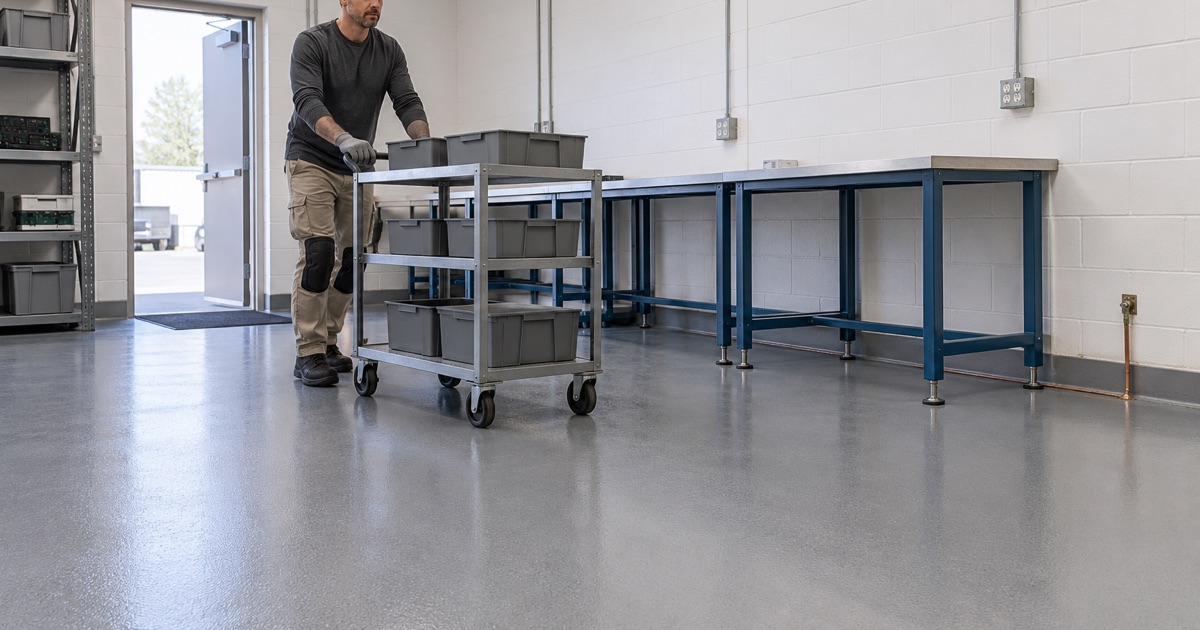
A static-control floor gives electric charge a controlled path from a person or a cart to ground. Conductive particles or fibers in the coating carry the charge through the system to copper grounding strips or points connected to the building’s ground.
Conductive Versus Static-Dissipative
Conductive floors have lower resistance and drain charge quickly. Static-dissipative floors have higher resistance and drain it more slowly. The right choice depends on the equipment being protected, the standards your facility follows and how people and products move across the floor.
The Floor as Part of a System
An ESD floor works together with conductive footwear, heel straps, grounded workstations and carts. A perfect floor will not protect a component if a worker’s shoe soles insulate them from it. We help you think through the whole path to ground.
Building an ESD Epoxy Floor
Prep and Moisture Testing
We grind the slab to the profile the system needs and test for moisture, because vapor pushing up through the slab can lift any coating. If readings are high, a moisture-mitigation primer goes down first.
Grounding Points and Conductive Primer
Copper grounding strips are laid out on the primed floor at spacing set by the system, and they are connected to building ground. A conductive primer or layer then ties the strips together under the topcoat.
Static-Control Topcoat
The final layer is a static-dissipative or conductive epoxy that carries the charge from the surface down to the conductive layer. It is a seamless, chemical-resistant and cleanable surface that suits clean manufacturing spaces.
Where ESD Floors Are Used
Electronics Assembly and Repair
Circuit boards and components can be damaged by static discharge during handling. Assembly lines, repair benches and test areas are the most common places for ESD floors.
Data Rooms and Server Spaces
Server and telecom rooms use static-control floors to protect equipment and reduce the risk of discharge when people move between racks.
Labs and Clean Manufacturing
Some laboratories and pharmaceutical or medical device spaces need static control alongside a seamless, cleanable floor. ESD epoxy systems can be specified to provide both.
Areas Near Flammable Materials
Where solvents, powders or vapors are handled, preventing sparks is a safety concern. A conductive floor can be part of the control strategy, specified by your safety engineer.
Testing and Verification
Resistance Testing After Cure
We measure resistance surface to surface and surface to ground at many points across the floor using calibrated meters. The readings are compared with the resistance range specified for the space.
Documentation for Your Records
You receive the test readings and their locations, which become the baseline for future checks. Periodic retesting shows whether cleaning practices or wear are changing the floor’s performance.
Scheduling and Compliance
Installing Around Operations
ESD floors usually go into active facilities. We phase the work, run overnight and weekend shifts and coordinate with your team so production can continue in areas not under construction.
VOC Limits and Local Rules
We choose products within Illinois VOC limits for floor coatings, which bind the installer as well as the manufacturer. Because Illinois has no state license for coatings work, we confirm each town’s registration and insurance requirements before scheduling.
What Affects ESD Floor Performance
Humidity and Seasonal Change
Static builds up most easily in dry air, and Lake County winters bring long stretches of low indoor humidity once the heat is running. A floor that tests well in a humid summer still has to perform in January. That is one reason the resistance range is specified for the space and tested at handover, rather than assumed from a product sheet.
Dirt, Wax and the Wrong Cleaners
A layer of dirt or a floor wax can insulate the surface and change how charge moves through it. Cleaning with products approved for static-control floors and keeping grit off the surface protects the readings. If a floor starts testing outside its range, cleaning is the first thing to check.
Wear in Heavy Traffic Areas
Cart wheels and foot traffic wear the topcoat over time, especially at workstation entries and along main aisles. Periodic testing shows where wear is changing performance, and those areas can be renewed before the whole floor needs attention.
Mixing ESD Zones With Other Floors
Transitions to Standard Coatings
Many buildings need static control only in certain rooms or along a production line. We can install ESD systems in those zones and a standard epoxy or urethane elsewhere, with clean transitions between them. Grounding is designed so each ESD zone has its own reliable connection.
- 20+ Years Coating Floors
- Moisture Testing in Every Scope
- Free Written Estimates