Waukegan Epoxy Flooring installs flake epoxy floors in Waukegan, IL, serving surrounding cities including Park City, Gurnee, North Chicago, Beach Park and Green Oaks. A flake floor is the most popular finish we put in garages, and for good reason: it hides dust and wear, adds texture and looks clean for years. In more than 20 years of laying them, we have found that the chips are the easy part. The bond underneath is what decides how long the floor lasts.
Every flake floor we install goes down over a diamond-ground or shot-blasted slab, never an acid-etched one, and every quote includes a moisture test as its own line. The proposal names the base coat, the chip blend and size, the topcoat and the finished thickness, so you can compare what you bought with what is on your floor.
Flake floors in Lake County also have to handle winter. Our systems are built to keep calcium chloride brine and rock salt on the surface, where they can be rinsed away, rather than letting them into the concrete.
How a Flake Epoxy Floor Is Built
Ground and Repaired Concrete
We grind the slab to the ICRI surface profile the system calls for, removing sealers, paint and weak surface paste. Cracks and spalls are filled and ground flush so they disappear under the broadcast. A flake floor hides small blemishes, but it does not hide a bad bond.
Base Coat and Vinyl Flake Broadcast
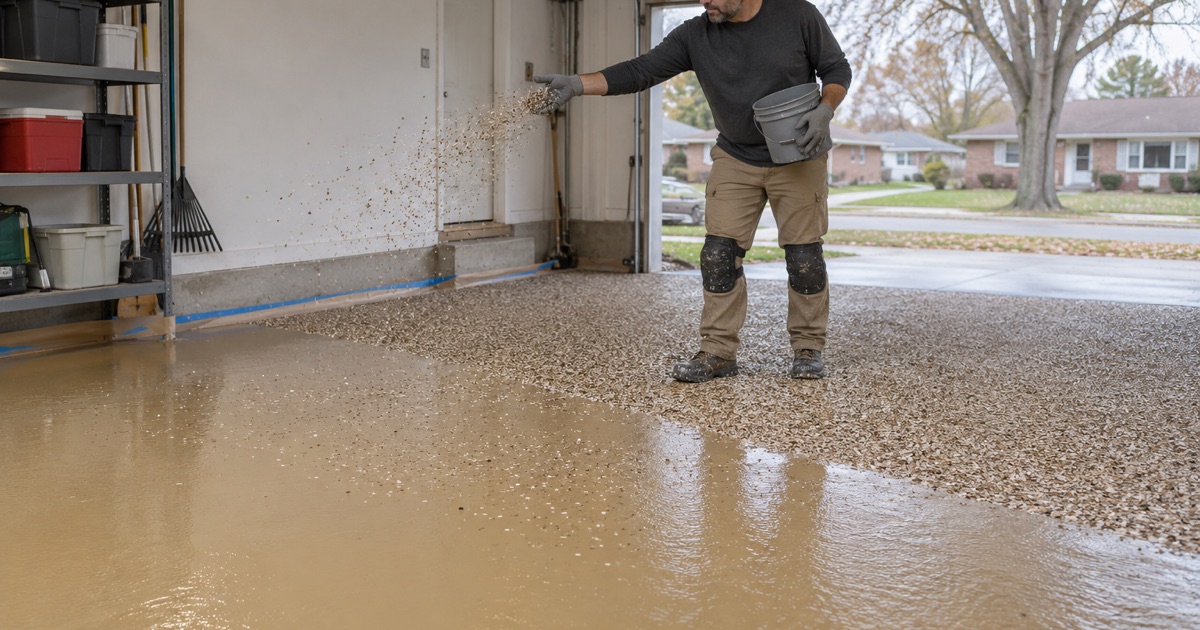
A pigmented 100% solids epoxy base coat goes down at a measured spread rate, and the vinyl flake is thrown into it while it is still wet. On most garages we broadcast to refusal, adding chips until the resin will take no more, which gives a dense, even layer. Once the base cures, the loose chips are scraped and vacuumed off.
The pigment of the base is usually matched to the dominant color in the blend, so if a chip ever wears thin, the color below it still fits.
Clear Topcoat
A clear polyaspartic or polyurea topcoat seals the chips. It fills the texture between them, protects them from wear and holds its color under sunlight from an open door. One or two topcoats can be applied depending on how smooth you want the finish and how hard the floor will be used.
Choosing Chip Blend, Size and Texture
Color Blends
Flake blends range from single colors to mixes of four or five that read like granite. Grays, tans and earth tones are the most common for garages because they hide road grime. Bolder blends work well in shops, showrooms and finished basements.
Chip Size
Small chips create a tight, uniform speckle; larger chips give a more varied pattern. Very large chips can feel slightly bumpy underfoot unless the topcoat is built up. We bring physical samples so you can compare them on your own floor.
Texture and Traction
The number of topcoats controls how smooth a flake floor feels. One coat leaves more texture and grip; two coats give a smoother surface that is easier to mop. An anti-slip aggregate can be added where wet boots and snowmelt make traction important.
Flake Floors for Garages and Beyond
Garage Floors in Salt Season
Winter brine from calcium chloride and rock salt is the main enemy of a bare garage slab. A sealed flake floor keeps brine on top, so a squeegee or hose can move it out. The topcoat also resists hot tire pickup, which is a common failure of thin store-bought coatings.
Basements, Laundry Rooms and Workshops
A flake floor gives a finished look to a basement, laundry room or workshop and makes cleaning easy. Basements get moisture testing first and a mitigation primer when the readings call for it.
Commercial Flake Floors
Showrooms, locker rooms, break rooms, veterinary clinics and retail back-of-house areas use flake floors for durability and easy care. We schedule commercial installations outside business hours and use systems within the Illinois VOC limits for floor coatings.
Caring for a Flake Floor
Routine Cleaning
Sweep or dust mop to keep grit off the surface, rinse winter brine out before it dries into a film, and wash with a pH-neutral cleaner. Harsh solvents and acidic cleaners are unnecessary and can dull the topcoat.
Recoating Worn Traffic Paths
After years of use, the topcoat in tire paths may dull. A light sanding and a fresh topcoat restore the floor without disturbing the chip layer, provided everything underneath is still well bonded.
What the Warranty Covers
Flake floor warranties typically exclude failure from moisture coming through the slab, slab movement and chemical damage. We read those exclusions to you, moisture first, before the job is sold.
Flake Floors Versus Kits and Shortcuts
Store Kits and Partial Chip Scatter
Most store kits use a thin water-based epoxy over an acid-etched floor, with a light scatter of chips from a small packet. The chips are mostly decoration, the film is thin and the bond is to a poorly prepared surface. Those floors often peel in the tire paths within a year or two, especially after a winter of brine and hot summer tires.
A professional flake floor uses a full-build base over a ground slab and a dense broadcast, so the chips are part of the wear surface rather than sprinkles on top.
One-Day Flake Systems
Some flake floors can be installed in a single day using fast-curing polyaspartic for every coat. That speed is useful, but only on a slab that is dry, sound and well ground. We recommend a one-day system when the slab supports it and a standard multi-day build when repairs, moisture or temperature call for more time.
Curing in Cool Weather
An unheated garage in a Lake County winter is usually too cold for a flake floor to cure properly. Coating it anyway risks amine blush, soft spots and a weak bond between layers. We schedule against slab temperature and the dew point rather than the calendar, and some garages simply go on the list for spring.
- 20+ Years Coating Floors
- Moisture Testing in Every Scope
- Free Written Estimates