
Waukegan Epoxy Flooring repairs concrete floors in Waukegan, IL, serving surrounding cities including Park City, Gurnee, North Chicago, Beach Park and Green Oaks. Most of the repair work we do happens before a coating goes down, because no finish can be better than the slab it is bonded to. After more than 20 years, we can usually tell at the first visit which cracks are finished moving, which spalls will patch cleanly and which slabs need more than a patch.
That honesty is the main thing we offer on a repair job. We read the cracks and any old coating before quoting, and if a section of the slab needs to be cut out and replaced before it can be coated, we say so plainly instead of selling a coating that will crack along the same line within a season.
Repairs are listed as their own lines on the proposal, by type and by length or area, so you can see exactly what is being fixed and what it costs.
Cracks in Garage, Basement and Shop Floors
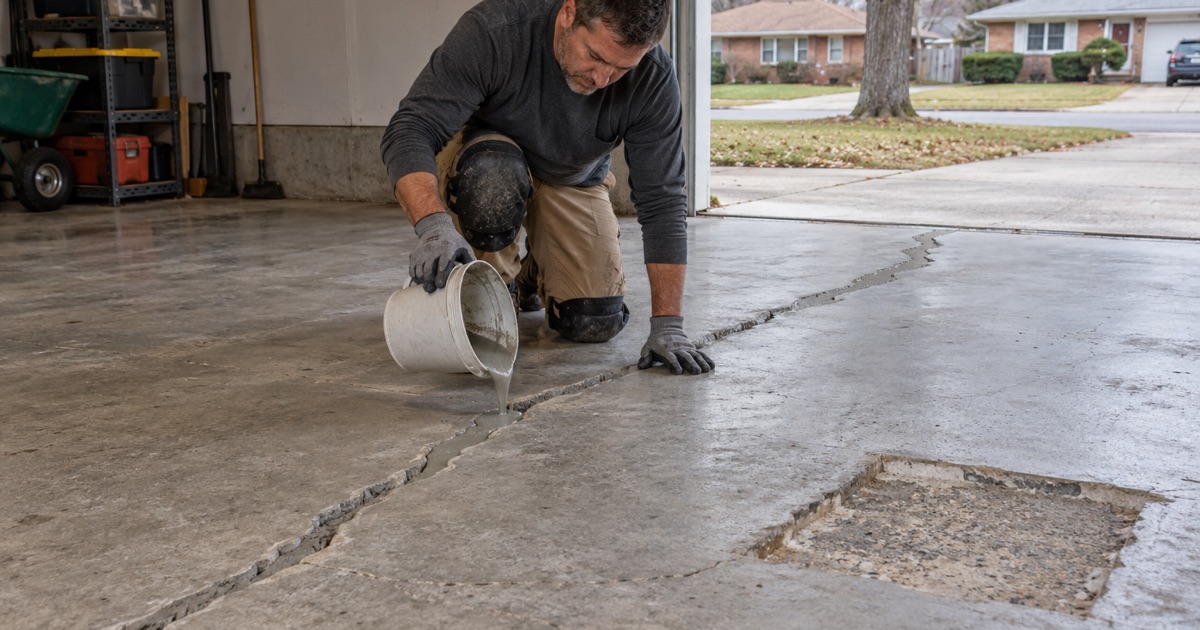
Shrinkage and Hairline Cracks
Almost every slab develops fine cracks as it cures and shrinks. They are usually stable and only cosmetic. We chase them open with a crack saw or grinder so the filler can get a real bite, then fill with a rigid epoxy or polyurea and grind it flush, so the repair disappears under a coating.
Moving and Offset Cracks
A crack with one edge higher than the other, or one that is wider in spring than in fall, is still moving. Frost heave, settlement over poorly compacted fill and clay till soils that swell and shrink with moisture all cause it. A coating is a film that follows the slab beneath it, so we never promise it will hold a moving crack together.
For these cracks we recommend a flexible joint filler, a deliberate saw cut that turns the crack into a control joint, or replacing the affected section. We explain the options and the likely outcome of each before you choose.
Cracks Around Drains and Posts
Cracks often radiate from floor drains, columns and the corners of sump pits, where the slab is restrained. We repair them and detail the coating to terminate cleanly around those features rather than bridging over them.
Spalls, Scaling and Surface Damage
Salt-Scaled Garage Floors
In a Lake County garage, the most common surface damage is scaling from calcium chloride brine and rock salt. The top layer flakes away near the door and under the tire paths, exposing rough aggregate. We grind off the weakened surface, rebuild it with a polymer-modified repair mortar or an epoxy mortar, and seal it so brine can no longer soak in.
Spalls and Popouts
Spalls are chunks broken out of the surface, often at joints or where something heavy was dropped. Popouts are small cone-shaped holes where a piece of aggregate near the surface has expanded and broken loose. Both are cut back to sound concrete and rebuilt flush with an epoxy mortar.
Worn and Dusting Surfaces
A soft or worn slab that leaves powder on a broom can be ground back to harder concrete and either densified or coated. If grinding reveals concrete too weak to hold a coating, we tell you before going further.
Control Joints and Slab Edges
Rebuilding Broken Joint Edges
Forklift and pallet jack wheels chip the edges of control joints until they become wide, ragged channels. We cut out the damaged edges, rebuild them with an epoxy mortar and fill the joint with a semi-rigid filler so wheels roll smoothly across.
Honoring Joints Under a Coating
Control joints exist because the slab will move there. We either fill them with a flexible material and coat over it, or carry the joint up through the coating so movement does not crack the finish in a random line.
Old Coatings, Patches and Leveling
Removing Failed Coatings
Peeling paint and failed epoxy have to come off before a repair or new coating can bond. We grind or shot blast them away and inspect the concrete below, because a failed coating often points to a moisture or prep problem that must be addressed.
Patching Low Spots and Ponding Areas
Low areas that hold water after mopping or after snowmelt can be built up with a patching compound or an epoxy slurry. We also check the pitch toward drains in garages and shops so water runs where it should.
When Replacement Beats Repair
Signs a Slab Section Must Come Out
Large sunken sections, heaved slabs, wide cracks with significant offset and concrete that crumbles under the grinder are signs that repair will not last. In those cases we recommend replacing the section first. In Waukegan, replacing any slab needs a city permit, and other towns have their own permit and contractor registration rules.
Coordinating Replacement and Coating
When part of a garage floor is replaced, the new concrete must cure before it can be coated, and it must be tested for moisture. We plan the timing so the coating goes on when the new section is ready, not when the schedule would like it to be.
The joint between old and new concrete is also a place where movement concentrates. We treat it as a control joint under the coating rather than bridging it with a rigid fill that would crack in the first freeze.
- 20+ Years Coating Floors
- Moisture Testing in Every Scope
- Free Written Estimates